
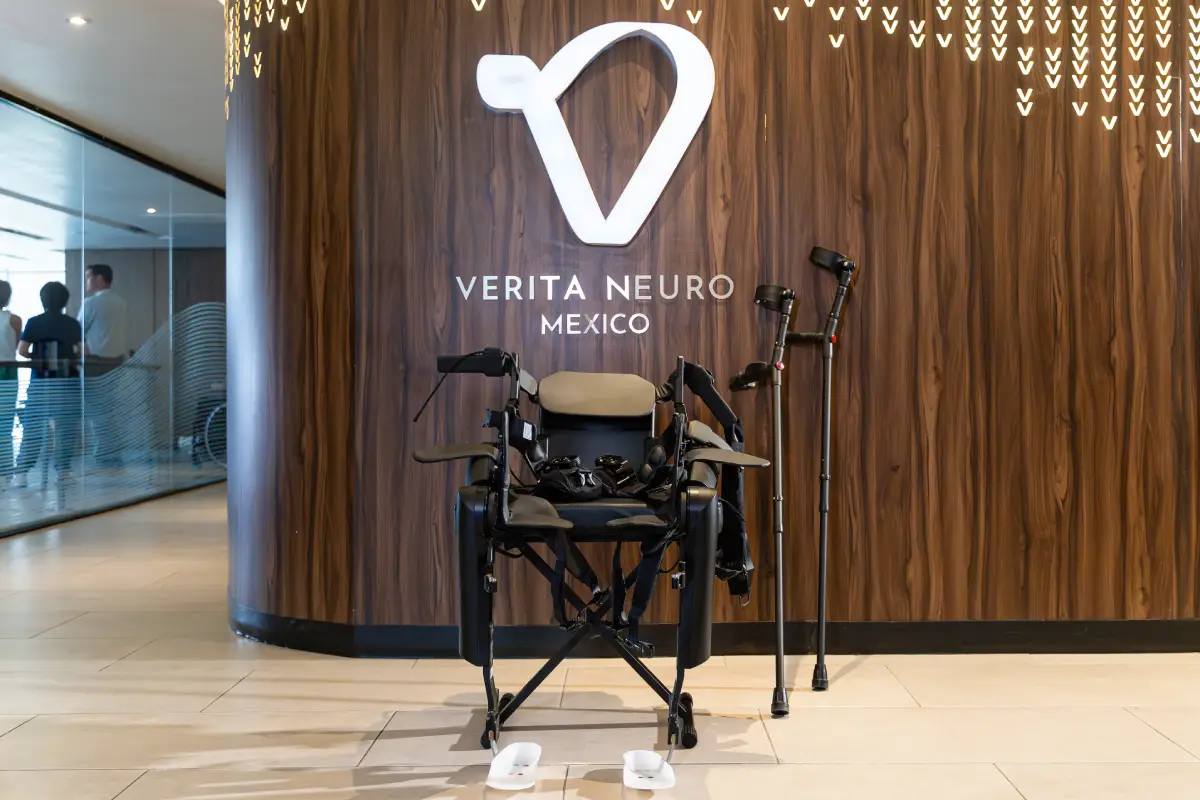
A Robotic Exoskeleton is a wearable, motorized frame worn over the legs, hips, and at times torso. Small motors at the joints move the legs through a natural walking pattern, while the person stays balanced with the support of crutches or a walker. For someone living with a spinal cord injury, exoskeletons can mean standing upright and taking steps again, often for the first time since the injury.
Robotic Exoskeletons have become one of the most significant advances in neurological recovery, the process of restoring function lost to injury or disease. The article explains what a Robotic Exoskeleton is, how it works, what it can realistically achieve, and how Verita Neuro applies the ReWalk Exoskeleton within its treatment programs.
What is a Robotic Exoskeleton?
A Robotic Exoskeleton is a wearable powered device that enables repetitive, task-specific walking by assisting hip and knee movements.
It is not intended to completely replace a wheelchair. Instead, it gives the body a way to stand, bear weight, and walk with assistance or supervision, which the muscles alone can no longer achieve after a serious injury.
The spinal cord is the main communication line between the brain and the body. A spinal cord injury interrupts that line, so signals instructing the legs to move can no longer be transmitted. The result is paralysis or weakness below the level of the injury. For paraplegic SCI patients, a Robotic Exoskeleton compensates for it by driving the leg movement directly, so that the person can stand and walk again. All research points to benefits of robotic exoskeleton use, most importantly that guiding the body through repeated, correct movement appears to support the nervous system’s own recovery.
Even though powered walking devices are studied in recovery from stroke and in multiple sclerosis, much of the strongest evidence for these devices comes from spinal cord injury recovery, and that is the focus of this article.
Medical Robotic Exoskeletons vs. Consumer Robotics
The word “exoskeleton” covers two very different groups of devices, and the distinction matters before going further.
Consumer robotics are built for people who can already walk, they supplement the effort of legs that can function and move independently. Such devices are designed for convenience or performance, for example, to make hiking easier or to lighten a heavy load. They are not medical equipment, they are not tested for recovery after injury, and they cannot enable a SCI patient to stand up, support their body weight, or move legs that have lost movement.
Medical Robotic Exoskeletons are designed for individuals who cannot walk or bear weight independently due to neurological, muscular, or spinal impairments. Medical exoskeletons assume critical biomechanical functions normally performed by the human body. They provide balance support, maintain upright posture, bear the user’s body weight, and actively generate coordinated movement. As a result, they function as assistive or rehabilitative medical devices rather than performance-enhancing consumer products.
To qualify as medical devices, these Robotic Exoskeletons are reviewed and approved by regulating medical bodies in their respective countries, for example the United States Food and Drug Administration (FDA), before they reach patients. This is the only group suited to neurological recovery, and it is the focus of all the information that follows.
How a Robotic Exoskeleton Works
A medical Robotic Exoskeleton operates by detecting the user’s movement intentions through sensors and control systems, then generating the corresponding leg and body movements on their behalf:
- Sensors. These are small instruments that detect a shift in the person’s balance or a lean of the upper body. When a person moves their weight forward, the sensors register it as the intention to take a step.
- The control system. This is the onboard computer that reads the signals from the sensors and determines what should happen next. It calculates the timing and length of each step, then sends instructions to the motors.
- The motors. Positioned at the hip and knee of each leg, they move the joints through a smooth walking pattern. The medical term for a person’s walking pattern is “gait,” and producing a steady gait is the core function of the device.
Two more elements keep the person safe and upright. Crutches or a walker provide balance and allow the person to guide their direction. Plus, a trained handler remains alongside during use. Together, these allow a person to move through three actions like standing up, walking, sitting back down, and sometimes even climbing steps.
What's Realistically Possible With a Robotic Exoskeleton
Outcomes when using an exoskeleton vary from person to person, and the level of the injury shapes much of what is possible. With that in mind, the gains observed in research and in practice fall into a few clear groups.
Regular movement
After a course of training, many people with a spinal cord injury can stand independently, walk indoors or outside with support, and sit back down without assistance. For example, studies of the ReWalk® 7 Personal Exoskeleton report walking speeds of roughly 0.28 to 0.60 meters per second after about 45 training sessions, with some users covering close to two kilometers in an hour of walking. The same research indicates that around 45 sessions are needed to reach most of a person’s final skill, which is why steady, repeated practice is so important.
Additionally, some exoskeletons like ReWalk even enable the patients to climb steps and mild slopes. This enables access to many familiar indoor and outdoor environments and further facilitates independence.
Physical health
Standing and walking on a regular basis load the bones and engage the muscles in ways that sitting cannot. Reported physical benefits from using an exoskeleton benefits include:
- Improved circulation
- Better bowel and bladder function
- Reduced muscle stiffness, the involuntary tightness that often follows a spinal cord injury
- Easier breathing, because an upright posture opens the chest and allows the lungs to work at full capacity
- Lower risk of pressure injuries, the skin damage caused by remaining in one position
Psychological well-being
Standing at eye level with family and friends, taking steps again, being able to walk around the house or the neighbourhood tends to improve mood, confidence, and motivation. Many people describe a restored sense of independence that wheelchair use alone did not provide.
Potential neurological recovery
The nervous system has a capacity called neuroplasticity, which is ability to reorganize itself and form new connections after damage. For many years, recovery after a spinal cord injury was considered fixed and final, however, modern research has shown otherwise.
When spared nerve pathways receive the right signals, they can strengthen and take on more work. Studies of exoskeleton training have recorded signs of genuine neurological change, including stronger voluntary muscle activity in people who had very little before. In other words, Robotic Exoskeletons may help the nervous system relearn the movement itself.
This is where injury severity becomes a core factor. A spinal cord injury is classified as either complete or incomplete. A complete injury means no movement or feeling below the injured level, while an incomplete injury means some signals still cross the damaged area.
People with an incomplete injury generally have more capacity for recovery, because more surviving pathways remain to strengthen. Even so, many people once classified as having a complete injury retain a small number of intact connections, and intensive training may make better use of them. None of this guarantees a particular result, a realistic plan always begins with a medical assessment.
The Science Behind Exoskeleton-Assisted Recovery
A growing body of research points to real change within the nervous system, driven by neuroplasticity and related processes discussed above. Several distinct processes appear to work together:
- A reawakened stepping rhythm. The spinal cord contains small networks known as Central Pattern Generators (CPGs), which can produce a basic stepping rhythm even without full direction from the brain. Repeated exoskeleton-assisted stepping supplies these networks with a steady signal, which may help reactivate them and improve coordination between spinal and supraspinal (above the spine) networks.
- A stream of sensory information. Every assisted step sends signals from the legs back toward the spinal cord and brain. These originate from tiny sensors inside the muscles, tendons, joints, and the soles of the feet. Repeating them session after session may help the nervous system relearn how correct movement should feel.
- Positive change within the brain itself. Imaging studies conducted after repeated walking practice show measurable changes in the regions that plan and control movement, such as the primary motor cortex or the premotor cortex. As those regions adapt, the healthy pathways that remain can carry their signals more efficiently.
- Stronger surviving connections. Many injuries described as “complete” still leave a few microscopic nerve links intact. Intensive, repeated practice may strengthen these survivors until faint signals begin to cross the injured area once more.
- A supportive chemical response. Repeated exercise prompts the body to release natural proteins that help nerve cells survive and grow. The best known is Brain-Derived Neurotrophic Factor , usually shortened to BDNF, and these proteins support the gradual work of nerve repair.
Evidence on Benefits of Exoskeleton Use
Researchers often express the strength of a result as an “effect size,” a single number describing how large a change is. Values near or above 0.8 are generally considered large. By that measure, exoskeleton training performs well:
- Walking speed, measured by the 10-Meter Walk Test: effect size of about 0.91
- Walking endurance, measured by distance covered in six minutes: about 0.75
- Lower extremity motor score (LEMS): between about 0.65 and 1.33
- Walking independence, measured by Walking Index for SCI (WISCI-II): between 0.76 and 2.17
In early rehabilitation, people training with an exoskeleton improved more significantly than those receiving standard rehabilitation alone. Benefits have been recorded both within and beyond six months after injury.
The adverse effects of using robotic exoskeletons are minimal, including very rare mild pain, temporary fatigue and skin lesions associated with training.
Using a Robotic Exoskeleton at Home
A Personal Robotic Exoskeleton is built for life outside the clinic, in the home and in everyday outdoor settings. That access brings clear advantages, along with limits that warrant honest attention.
Using a Personal Robotic Exoskeleton provides health benefits due to consistency. Recovery depends on repetition, and a device kept at home allows standing and walking to become part of daily life rather than something reserved for a clinic visit. Day-to-day independence is the other gain, such as standing to reach an overhead shelf or walking a short distance.
The ReWalk® 7 Personal Exoskeleton Available at Verita Neuro
The ReWalk Exoskeleton is one of the most thoroughly studied powered walking devices available for people with a spinal cord injury, and it remains among the leading options for both clinic-based recovery and as a personal mobility device. It has gathered one of the largest bodies of clinical evidence of any device of its kind, with measured benefits in walking performance, everyday mobility, and overall recovery.
Two features set it apart for life at home. The ReWalk Exoskeleton is the only device of its kind able to manage stairs, curbs, and mild slopes, terrain that keeps most other exoskeletons limited to indoor and completely flat surface use. It is also approved for home use by the United States Food and Drug Administration (FDA).
ReWalk Exoskeleton consists of motorized joints at the hip and knee, a wearable support frame and crutches for balance, sensors that track movement and balance, and smart watch. Together these elements allow a person to stand, walk, turn, and sit with the support of forearm crutches.
After about 40 hours of training, people with a long-standing spinal cord injury commonly reach:
- Walking speeds between 0.28 and 0.60 meters per second
- Distances of 0.74 to 1.97 kilometres in an hour of walking
- The ability to stand and sit without help
- Comfortable walking indoors
- Better balance and steadiness on their feet
Research suggests that roughly 45 sessions are needed to reach about 80% of a person’s final walking skill, which is why structured, repeated practice matters so much.
User satisfaction scores are consistently high, with people describing positive experiences of standing, walking, and taking part in their own recovery. The results can reach even further when Robotic Exoskeleton use is paired with other treatments such as Stem Cells.
References
- Effects of an exoskeleton robot on motor function in patients with spinal cord injuries: a systematic review and meta-analysis. Systematic Reviews. 2025. Guo S, Yang Y, Wang M, Wang D, Zhang Y, Wang Q, Deng Y.
- Comparative efficacy of robotic exoskeleton and conventional gait training in patients with spinal cord injury: a meta-analysis of randomized controlled trials. Journal of NeuroEngineering and Rehabilitation. 2025. Liu S, Chen F, Yin J, Wang G, Yang L.
- Exoskeletal-Assisted Walking During Acute Inpatient Rehabilitation Enhances Recovery for Persons with Spinal Cord Injury — A Pilot Randomized Controlled Trial. Journal of Neurotrauma. 2024. Tsai CY, Weinrauch WJ, Manente N, Huang V, Bryce TN, Spungen AM.
- Effects of Robot-Assisted Gait Training in Individuals with Spinal Cord Injury: A Meta-analysis. BioMed Research International. 2020. Fang CY, Tsai JL, Li GS, Lien ASY, Chang YJ.
- Retraining walking over ground in a powered exoskeleton after spinal cord injury: a prospective cohort study to examine functional gains and neuroplasticity. Journal of NeuroEngineering and Rehabilitation. 2019. Khan AS, Livingstone DC, Hurd CL, Duchcherer J, Misiaszek JE, Gorassini MA, Manns PJ, Yang JF.
- Device-Training for Individuals with Thoracic and Lumbar Spinal Cord Injury Using a Powered Exoskeleton for Technically Assisted Mobility: Achievements and User Satisfaction. BioMed Research International. 2016. Platz T, Gillner A, Borgwaldt N, Kroll S, Roschka S.
- Overground robotic training effects on walking and secondary health conditions in individuals with spinal cord injury: systematic review. Journal of NeuroEngineering and Rehabilitation. 2022. Tamburella F, Lorusso M, Tramontano M, Fadlun S, Masciullo M, Scivoletto G.