In a recent Live, Nean, Verita Neuro’s physical therapist, was joined by a T5 -T6 spinal cord injury patient, Igor from Ukraine, and Dr. Nasir Majeed, Global Medical Director & Head of Research and Development, to discuss what Epidural Stimulation for Spinal Cord Injury recovery can look like.
The conversation covered Igor’s ongoing recovery, how treatment and rehabilitation is being monitored, and why progress after spinal cord injury can mean much more than walking.
Igor sustained a complete T5 -T6 spinal cord injury after a car accident in 2024, and underwent Epidural Stimulation surgery at Verita Neuro in 2025 before continuing rehabilitation. During the live session with Dr Nasir and Nean, he described changes in his ability to stand, control his trunk, manage bowel and bladder function and live a more independent life.
Igor’s experience highlights one of the most important parts of spinal cord recovery: progress is different for everyone, and meaningful improvements can involve many aspects of daily life.
What Can Spinal Cord Injury Recovery Look Like?
Is recovery only about walking?
Dr Nasir: We have had many patients who were fully paralyzed before the treatment and they regained functions to be able to stand and walk with upper body support with the help of a walker. We also have had patients who are able to walk with crutches.
In addition, we had patients who regained bowel function, bladder function, sexual function and other autonomic functions such as blood pressure regulation. So it’s not only really walking, it’s the other functions like autonomic functions and overall quality of life we look at.
For many people living with a spinal cord injury, learning how to walk again is one of the most important goals, however it is not the only measure of progress. The ability to perform every day activities can also make a huge difference to quality of life after a spinal cord injury.
What changes did you experience after Epidural Stimulation?
Igor: I’m standing with stimulation, and I can stand for 40 to 45 minutes. I do it two times per day. The muscles in my trunk, body and spine are getting better because I can take control of my body.
In the first few months after I got the stimulator, I could stand for 10 or 15 minutes, and it was difficult. Now it’s very easy. I’m standing for 45 minutes. I just need support from one finger.
With my bowel, it’s easier to do it. I don’t need too much time, and I start to feel when I want to do it. For the last year with stimulation, I haven’t had any accidents. With the bladder, I don’t use any catheter.
How can standing become part of recovery?
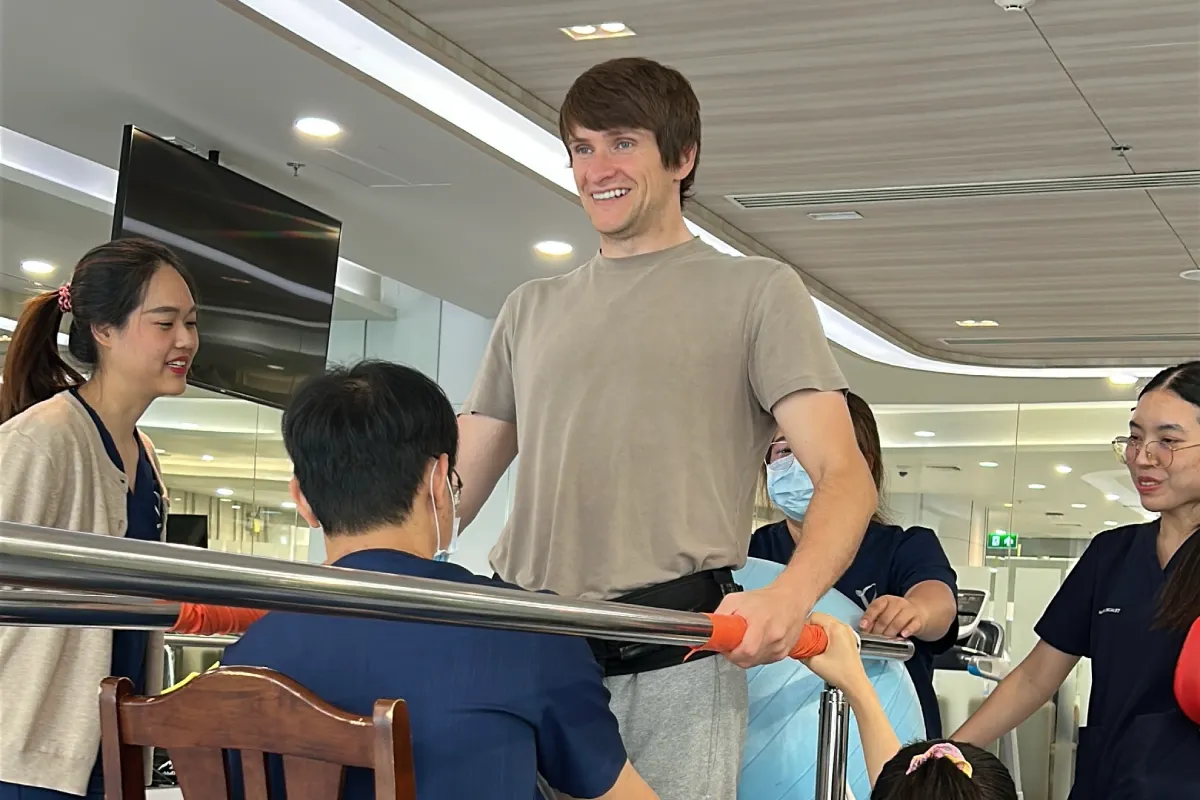
Igor: We started with two minutes standing, three or five. It was a victory for me. Now I can easily do 40 or 45 minutes.
Nean: After his first treatment, Igor could stand with the standing machine. He needs less effort to stand. He can now talk more when standing, which is very different from when he had rehabilitation sessions with me. He can now walk with the program on, but he walks in the exoskeleton. He still needs gait aids and support.
What does Epidural Stimulation treatment do?
Dr Nasir: We implant an electronic stimulator with paddle electrodes. Those are contact electrodes implanted into the epidural space in the lower back to trigger rhythmic locomotion in patients with spinal cord injuries. It’s a treatment used to improve motor function and autonomic functions in patients with traumatic or non traumatic spinal cord injuries.
It involves a small surgery called laminectomy to implant the electrodes. After the treatment, we do a very specialized process called mapping. Mapping is when the stimulator is turned on and we optimize the electrical parameters based on the patient’s individual spinal circuitry to enhance motor functions.
What does mapping spinal stimulation look like?
Nean: At first, we look for combinations of the electrodes in the stimulator and the reactions your body gets. That could be movement in your legs, your knee bending, or squeezing in your trunk. Those could be potential programs to help you balance yourself when you’re sitting or standing. We also try to see programs that help with activities of daily living, like bladder and bowel control. Sometimes the program helps patients perform these tasks more easily, with less effort.
The process from the beginning is a little slow. If you want to stand, you wouldn’t be able to stand 100% on your own straight away. We go step by step with gait aids, and your muscles need to train and get stronger day by day. It all works together.
Why is rehabilitation still essential?
Dr Nasir: We can think of spinal cord stimulation as a tool that enables patients to regain a certain level of mobility. They have a certain level of control and motor function. However, to make it functional for day to day life, they have to build on the initial recovery.
Physical therapy is important for patients to regain better control and a better range of movements over time. It’s like relearning how to walk again from scratch. The process is similar to how babies learn to walk, with training.
Post treatment rehabilitation is very important. If someone is able to follow through with extensive physical therapy, rehabilitation and locomotive training, recovery is normally faster. It also depends on what they do after treatment in terms of rehabilitation.
Why is Every Spinal Cord Injury Recovery Different?
Does the level of injury affect recovery?
Dr Nasir: There is a difference between paraplegic and quadriplegic patients in terms of the timeline. In our experience, recovery in paraplegic patients is faster compared with patients with quadriplegic spinal cord injuries. This is mostly because of the limitations they face when they use their upper limb.
For patients with quadriplegic spinal cord injuries, we implant two stimulators. One stimulator is implanted in the lower cervical spine at C7 level, which is the trigger center for upper limb movements, and the second implant is like Igor received, for lower limb recovery. We have to map upper limb functions and lower limb functions. Generally speaking, recovery in the upper limbs is slower than in the lower limbs.
Does the amount of time between injury and treatment matter?
Dr Nasir: The first two years are important, but it also depends on the nature of the injury, the level of injury and the structure of the body. Post treatment rehabilitation is also very important. If someone is able to follow through with extensive physical therapy, rehabilitation and locomotive training, recovery is normally faster.
Can a complete spinal cord injury still have spinal cord continuity?
Dr Nasir: Even if patients are classified as having a complete spinal cord injury, this does not necessarily mean they have a severed spinal cord. This means they have a functionally complete spinal cord injury, for example, complete loss of motor and sensory function.
When we look at the spinal cord on the spinal MRI, we can verify whether there is continuity of the spinal cord tissue. This is required for Epidural Stimulation. Even if it’s a functionally complete injury, as long as there is continuity of the spinal cord tissue, Epidural Stimulation is an option for those patients.
What can recovery look like beyond walking?
Dr Nasir: We have had many patients who were fully paralyzed before the treatment and they regained enough functions to be able to stand and walk with upper body support, with the help of a walker. We also have had patients who are able to walk with crutches.
We had patients who regained good bowel function, bladder function, sexual function and other autonomic functions, for example, blood pressure regulation. It’s not only walking; it’s the other functions, like autonomic functions, bowel and bladder functions, and blood pressure regulation. We look at overall quality of life.
Igor: I can do everything by myself.
What happens when a patient leaves Verita Neuro?
Igor: I continue my rehabilitation, and I still have training every day. I’m standing with stimulation, and I can stand for 40 to 45 minutes. I do it two times per day.
I walk 3 times per week for 2 kilometres in a robot. I have massages and acupuncture. Every three months, I receive Stem Cell treatment.
Nean: The key to keep getting more progress in your rehabilitation is that you cannot stop. You need to keep carrying on with the schedule.
What other treatments are available?
Dr Nasir: Spinal cord stimulation is the more comprehensive approach, and the best possible option for many patients with spinal cord injuries. However, not everyone qualifies for this kind of treatment. We do have other options based on regenerative medicine. We also have ReWalk exoskeleton. It’s a robotic device which allows patients to sit, walk and climb stairs in community settings. This exoskeleton gives real life mobility to patients with lower thoracic spinal cord injuries. We also have neurorehabilitation for some patients.
Stem Cell treatment can be part of spinal cord injury recovery. It’s also an important tool we can use to promote the regeneration of spinal cord tissue.
What should someone do if they are considering Epidural Stimulation?
Dr Nasir: We request certain medical scans, most importantly a spinal MRI scan, because this is by far the most important way for us to visualize and confirm the location of the injury, the nature of the injury and other spinal cord findings which are important for someone to qualify for spinal cord stimulation.
We request information about clinical symptoms, medical history, past surgeries and treatments, and expectations. Each patient goes through a comprehensive medical evaluation process. Then we have a one on one medical consultation with each patient to verify the findings, explain the treatment in detail and answer any unanswered questions. We send a treatment program to the patient, who is free to decide when and how they would like to proceed.
Nean: Anybody who’s considering the treatment options, feel free to reach out to us so we can have a consultation and evaluation, as well as discuss the treatment options best for your condition.
What does Igor’s story tell us about spinal cord injury recovery?
Igor: At the beginning of my journey after the accident, I realised that recovery is a marathon, not a sprint. It is a lifelong journey and whether it takes 5, 10, 15 or even 20 years, I am ready to keep going.
Some days are better than others and that is life. All you can do is give your best, stay disciplined, keep training, maintain a positive attitude and never lose your smile.
The above is not a verbatim transcript of the YouTube live discussion. Some comments have been altered or rearranged to improve the reading flow. You can watch the full live on our YouTube channel.