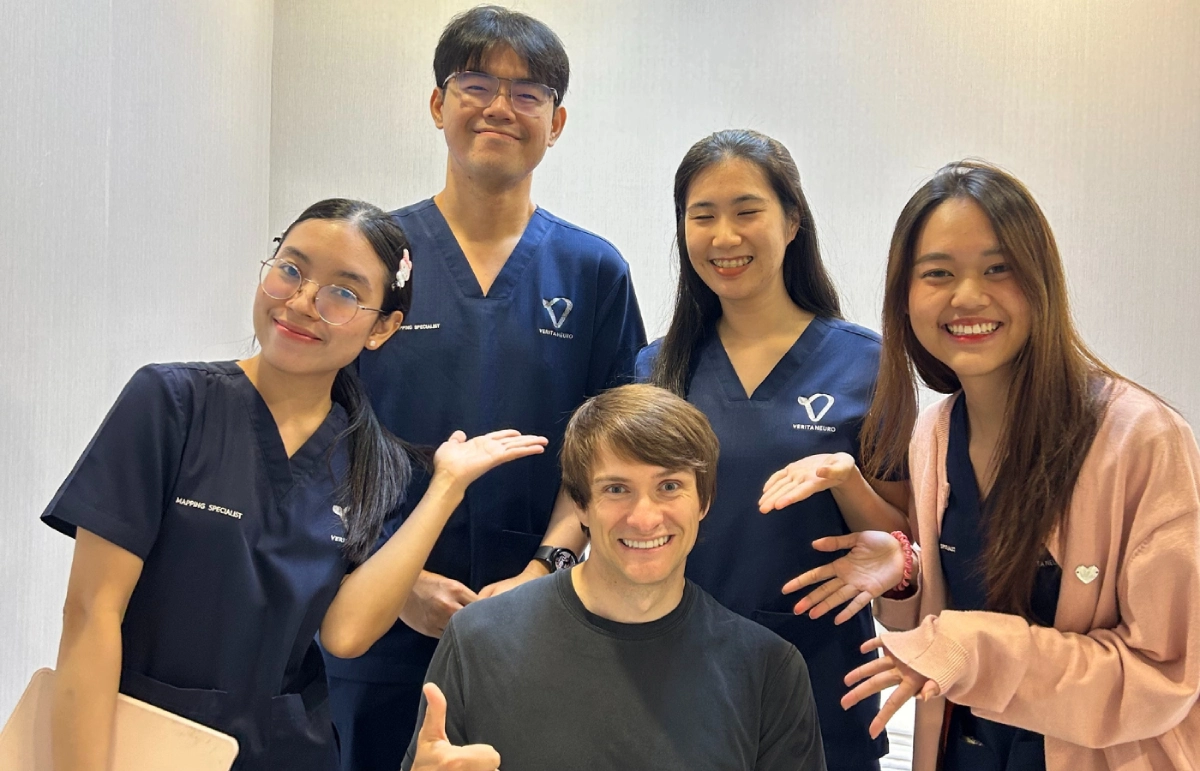
In a recent YouTube Live and Facebook Live Q&A session, Verita Neuro Patient Representative Vea Gaygon and Global Medical Director, Dr. Nasir Majeed, join patient Igor Sharanda to discuss his life after treatment. Igor is a paraplegic T5-T6 complete spinal cord injury patient from the Ukraine, who received Epidural Stimulation treatment at our hospital in Bangkok, Thailand, in August 2025.
A Conversation with Igor Sharanda
Igor: My name is Igor. I’m from Ukraine. I have a T5-T6 complete spinal cord injury from a motorbike accident in April 2024. I received Epidural Stimulation treatment at Verita Neuro in Bangkok in August 2025.
What Was Your Condition Like Before Treatment at Verita Neuro?
Igor: Before treatment, I had difficulty breathing because my injury affected my diaphragm level. I also had bladder issues. Now I can manage it myself because I can feel when my bladder is full. I still cannot control it fully, but I already understand what I need to do. Before, I also had bowel problems and sometimes couldn’t go for four or five days. Now I go every day, and it’s much better. I’m very happy about this. My erection has also improved. Before, it wasn’t working properly, but now it’s better.
My blood pressure is also better. Before, I could stand only with full support for about 10 to 15 minutes. Now I can stand without support for 30, 35, sometimes 40 minutes. It depends on me.
My back muscles and stomach muscles started to work. I feel it. I can sit straight now. I have very good control of my trunk now. I can now put on my hat and my headphones while sitting, and I can put on a jacket and T-shirt independently as well. Before, I had to lie down to do it. It’s just three months after surgery, but it’s completely changed, and it’s just starting.
Igor’s Experience with Epidural Stimulation
How did you first hear about Epidural Stimulation treatment at Verita Neuro?
Igor: I found it through ChatGPT. I was searching worldwide for solutions. One day it mentioned Verita Neuro in Bangkok and sent me a YouTube link. I started watching videos, and then I contacted you immediately. I remember it was very early in the morning for me. You replied very fast, and that gave me confidence.
Many patients are scared of undergoing surgery. Can you share your experience of the Epidural Stimulation procedure?
Igor: I wasn’t scared because I believed this could help me. I already understood that this was not magic and that it was a serious surgery, but I believed in it. When I met Dr. Nasir and the team, I trusted that everything would be okay.
The surgery itself was fast. I arrived on Sunday, and I had surgery on Monday evening. The first two or three days, there was some pain, but the medical team managed it well with medication. After that, it was okay.
We started training very quickly. On the second day, we already began rehabilitation. There was no time to lie in bed and think about pain. I understood there were risks, and the doctors explained them clearly, but I had already faced many risks in my life, so I accepted that.
What is Epidural Stimulation?
Dr. Nasir: Epidural Stimulation is a form of neuromodulation. It uses an implanted electrode and pulse generator to deliver precise electrical stimulation to specific spinal cord segments. This stimulation activates motor neurons, allowing muscle contractions in the lower limbs. With rehabilitation, these contractions can become controlled movements that help patients stand and potentially walk again.
Igor’s 30 Day Rehabilitation Programme at Verita Neuro
What did a typical day at Verita Neuro look like?
Igor: A typical day at Verita Neuro was like this. In the morning, I always started with breakfast. After that, I went to the hospital. We started training at 9:00 in the morning. We had about three hours of training including mapping and different kinds of occupational therapy and physiotherapy. There were exercises to practice standing and walking. We tried to find the best signal and set up the best program for my muscles, my legs, and my trunk.
After that, we had lunch, and then in the afternoon we went back to training again. Every day, it was about five hours of training in total. It was very nice because every day you feel improvement. Every day you have good training, and every day something is better.
What were your expectations going into treatment?
Igor: I was very realistic. I knew it wasn’t magic. I had already researched Epidural Stimulation thoroughly before I arrived and I knew that it couldn’t make me walk the day after the surgery. I understood that even after the treatment, I would need to continue physiotherapy at home for several hours every day. It’s not a fast process but it gives the possibility to stand and walk again. That’s what I see now, what I feel now.
I didn’t want to have big expectations and be disappointed later. My expectation was just to try. Now, after three months, I’m very happy with what has happened. I can see that it works.
How soon after surgery did you notice changes?
Igor: After one week. The first week, we couldn’t find the right signal to make my legs stand, and I was a little bit upset. I remember Dr. Nasir told me, “Igor, please wait. We know what we are doing.” Then he said, “Let’s set up one program and leave it on during the night.” The next day, when I came to the hospital and the medical team turned on the program, it was amazing. That moment was very emotional for me.
Dr. Nasir: This was an expected outcome for Igor’s case. We carefully assess eligibility before surgery and confirm responses during implantation. After successful implantation of the Epidural Stimulator, the most rapid motor movement gains are usually seen within the first two months. We’ve studied this pattern and proven it to be true for many patients.
But overall, Igor’s progress has been remarkable, and the stimulator will remain in his body for at least nine years, so there is still significant potential for improvement.
Were there moments during treatment that surprised you physically, mentally, or emotionally?
Igor: Yes of course. It was very emotional for me to see movement in my legs, to feel that I could move them, push them, stand, and walk.Before, many doctors in my country were very skeptical. They said I would never walk again and that I had no chance.
When I saw what I could do in Bangkok, it gave me hope. And more than hope, I really saw what I could do. I believed again that I could walk and have a better life. For my mindset, it was very important. I also started using social media for the first time because I wanted to share my experience and help others.
Igor’s Daily Life Post-Treatment
How does rehabilitation with Epidural Stimulation fit into your life now you’ve returned home?
Igor: My daily life is very busy. I train every day. I wake up at five in the morning and start training at six. I train for about two and a half hours at home. I do standing training, physical exercises, and some gym-style training.
After that, I go to work. I have my own business. I also have five children, so I have many responsibilities. When I come back home, I train again. I do standing and stretching. I don’t take days off. I train every day.
I use Epidural Stimulation a lot during the day. You gave me instructions, and I use it maybe eight hours per day. After the night, my body is very tense. When I turn on the stimulation, after about three minutes my body becomes flexible. It’s amazing. Before, transferring from bed to wheelchair was dangerous because my body was uncontrolled. Now, when I use the program for spasticity, my body is flexible and I can control my legs and movements better. I can put on clothes and move safely.
Dr. Nasir: That’s actually very good. The stimulator is designed for long-term use, even up to 24 hours if needed. It’s very safe, so the more you use it appropriately, the better the outcome.
I understand you’ve begun using robotics in your at-home rehabilitation. Can you tell us more about that?
Igor: Yes, I have also recently started training in a robotic system. I walked in the robot with Epidural Stimulation turned on. There is a screen that shows the signals in the legs. When we compared the signals without stimulation and with stimulation, the difference was very big. It shows that the signals are going to all my leg muscles.
Dr. Nasir: Many patients try different training methods such as robotics or exoskeletons. Some patients find them very useful. If robotics can be combined with stimulation, that’s good. But many patients don’t have access to such equipment, and that’s okay. Simpler walking frames and walkers are also very effective for training. What matters most is consistency and continued rehabilitation.
What has been your biggest achievement since returning home?
Igor: My biggest achievement is independently, especially at social events. When I first came back home, I could stand in a frame for maybe two or five minutes. Now I stand every day for about 30 to 35 minutes, three times per day.I have a standing frame that I keep in my car so when I go to friends or events, I take it with me. If I want to speak closely with someone, I stand and talk with them. Five months ago, I couldn’t believe this was possible. Now I can do it.
I can also drive a car on my own now, because I have strong trunk control. I have the ability to control my body while driving and to transfer myself from bed to wheelchair, and from bus to car.
Igor’s Vision for the Future
Vea: How has your mindset changed?
Igor: I really believe I will walk again in two to five years. I will do it. I already feel that I will do it.
Dr. Nasir: We are still in a very early stage. It has been four or five months since the treatment. Recovery can continue for three to five years to reach optimal outcomes. Igor is already able to use his legs to stand and walk with support. The stimulation is activating his muscles, and he is gaining better control. These are ambitious goals, but they are realistic.
Vea: Igor, what are your future plans?
Igor: My plan is to work together with you. My goal is to help open Verita Neuro in Ukraine. Many people in my country need this technology, especially now. Since I started sharing my story on social media, many people have contacted me asking for help. This is my dream, my goal, and my mission.
Vea: Any final message for others with spinal cord injury?
Igor: We live in a very good time. Technology is developing very fast. With today’s technology and artificial intelligence, we have a possibility to walk again. In three to five years, I’m sure we will talk about even more advanced technologies.
My message is to keep your body and your mindset in good condition. If we give it time, I believe everyone will have a chance.
The above is not a verbatim transcript of Igor’s live interview. Some comments have been altered or rearranged to improve the reading flow. You can watch the full live on our YouTube channel.