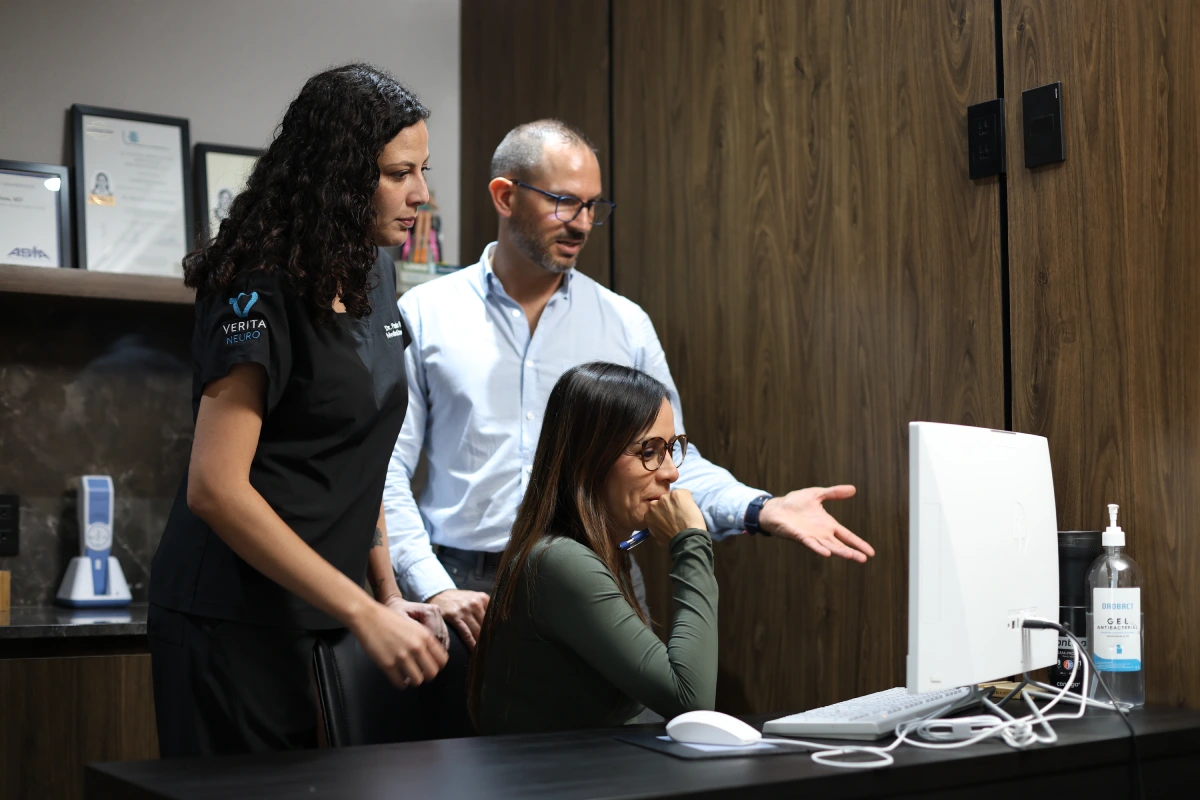
In a recent YouTube Live and Facebook Live Q&A session, Verita Neuro’s Medical Director, Dr. Beatriz Perez Hernandez, joined Director of Patient Services, Hanna Charles, to discuss neurorehabilitation after spinal cord injury. Key topics include the benefits of physical therapy for spinal cord injury, common misconceptions and challenges patients face, the latest mobility aid devices, and Dr. Beatriz’s best advice and hopes for the future of neurorehabilitation. The discussion also covers Epidural Stimulation and Stem Cell treatment, offering insights from Verita Neuro’s extensive clinical experience.
Misconceptions About Neurorehabilitation After Spinal Cord Injury
Hanna: What would you say to a patient who might think that they are too weak or too old to start neurorehabilitation?
Dr. Beatriz: Well, I think that when you have the goal to reach independence, it’s never too late. When patients are newly injured, they are often told by their doctors that they will never walk again. And so, these patients will often give up at that point and they lose precious time. However, there are still so many other goals that can be achieved to regain independence and restore quality of life, outside of simply walking again. For example, regaining bowel and bladder function, or autonomic control of blood pressure and body temperature. Restoring movement of any kind will help to avoid other complications like pressure ulcers and pulmonary complications.
So even if a patient feels they are too old, or too weak, or that it has been too long since their initial injury, we can absolutely work on all of these things. We can set so many other goals and walking is not always the most important thing. Although, certainly, we have helped many patients to take steps again when they and their doctors didn’t believe it was possible.
There is a Physical Therapist in Australia, named Natalia, who always says that there’s no static spinal cord injury in the world as long as you keep on moving. So sometimes I have patients who tell me, “I have a complete injury, there’s nothing I can do”. But no, spinal cord injuries which are complete can still become incomplete injuries, even years or decades after the injury occurred.
Hanna: What is your view on neurorehabilitation across a patient’s life? Is it something we do periodically, or something that can be “finished”?
Dr. Beatriz: I always tell patients that neurorehabilitation becomes like a habit, the same as brushing your teeth. You have to continue doing it all of your life. Just like all humans, even those who are able-bodied, we should never stop moving and exercising in whatever capacity we can.
But also, we as human beings always need some vacation or a break. So we can take breaks, we can take vacations, we can have periods where we don’t do three hours of intensive physical therapy exercises every day. But we can find plenty of other ways to keep moving, even during these breaks. Whether that is stretching, adaptive yoga, weightlifting or even kayaking, or table tennis.
We have had very inspiring patients who found new ways to keep doing the sports that they loved. Sofia, a C5-C6 complete spinal cord injury patient, has participated in wheelchair marathons. Brock, who was previously a professional motocross rider before his T6 complete spinal cord injury, took the opportunity to focus on a sport he didn’t have time for before the injury, which was golfing. He purchased an adaptive golfing device and even competes in tournaments now.
The Benefits of Neurorehabilitation For Spinal Cord Injury
Hanna: Can you tell us about your experience with the ASIA scale? What kind of changes have you seen? And maybe you can even explain a little bit about the scoring systems that we use and how patients tend to change over time.
Dr. Beatriz: Yes, so ASIA stands for the “American Spinal Injury Association”, which is an organisation both myself and Dr. Rodrigo are members of. They developed the “ASIA scale”, which is the gold standard for evaluating spinal cord injuries, internationally.
This impairment scale examines two specific major areas: movement and sensitivity. Motor function is examined through myotomes which are muscle groups controlled by a single spinal nerve. Sensory function is examined through dermatomes, or skin areas supplied by a single spinal nerve. So for each part of the body we assess, that will tell us how much nerve communication is still happening within each segment of the spinal cord.
The key factor that differentiates a complete from an incomplete injury is the sacral segments of the spine, specifically S2 to S4. When we apply the ASIA scale to a patient, we check for sensation or motor function in those segments. If there is no function there, the injury is classified as complete (ASIA A). If some sensation or motor control remains, it becomes an incomplete injury, classified from ASIA B through to E.
The grade also comes with a “level”, which refers to the lowest spinal cord segment with normal motor and sensory function, L1 being the lowest and C1 being located at the base of the skull.
Often, people believe that their initial ASIA assessment will never change but we have seen this change and improve many times. One patient comes to my mind, who arrived at Verita Neuro in Mexico 12 days after his injury, and he moved from an ASIA A score to an ASIA E in 35 days, using regenerative medicine. We also had a patient who arrived three months after her injury and had an ASIA A grading, but then she ended as scale D, with sensation and movement 9 levels lower in her spine.
Challenges To Overcome During Neurorehabilitation
Hanna: Could you tell us, since you’re in the clinic with the patients every day, about the emotional transformations you see in patients and their families when they start to see the progress from epidural stimulation, stem cell treatment, and neurorehabilitation?
Dr. Beatriz: One of the most emotional changes that comes to mind is autonomic function and control of the bowel and bladder. Imagine, just try to picture right now, being an adult and needing someone to change your diaper or to support you while you pee or make a bowel movement. It can really depress our patients.
So in the beginning when they get to the clinic, we’re often using a Foley catheter and they’re having to take pills in order to have a bowel movement, or maybe even suppositories. The day when the urologist arrives to remove their Foley catheter is such a happy day, you can see the gratitude in their facial expressions.
This can bring dramatic changes to their lives. They can get into a pool as a recreational activity. They can have a sexual life. They don’t have to live in fear of having an accident in public. Where before they were having frequent infections and UTI’s, this will significantly reduce. And they no longer have to have a catheter on display, which is so important. One of the biggest challenges of people with neurological conditions is having the bravery to go to social places, restaurants, parties, or the movies.
Even before they see any results, just being gathered together at the gym with other spinal cord injury patients can be very helpful emotionally. To see that they’re not the only person in the world with this neurological condition can make it easier to laugh and be happy. And to socialise with our Physical Therapists, who work with paraplegics and quadriplegics everyday and don’t treat them differently. Patients can feel very isolated when they are first injured so these are all great experiences for them.
Hanna: I wanted to talk about patients with spasticity and neuropathic pain who might be reluctant to start neurorehabilitation because of the fear of the pain or the spasms not allowing them to do it. How would you approach those cases?
Dr. Beatriz: Well, spasticity is present in all patients who have injuries in the central nervous system. That could be stroke, multiple sclerosis, cerebral palsy, and of course, spinal cord injury, which are the most common conditions that we see here at the clinic. But, actually, a bit of spasticity is not bad for us. We definitely want to have some spasticity to help with movements, for standing up and knee blocking, and to help maintain muscle mass. But if this spasticity is very painful, or decreasing your quality of life, our treatments will help with this. We can use Epidural Stimulation, targeted physical therapy, we can prescribe medications, or we can inject Botox into your muscles. It’s temporary and the effect lasts from 3 to 6 months, at which time we can repeat if needed.
Neuropathic pain is not always present and we have different ways to treat it. First of all, we have some medications that can help, as well as specific physical therapy techniques. For patients who receive an Epidural Stimulator, our mappers can program specific channels to treat neurological pain.
Advice for Patients Starting Physical Therapy At Home
Hanna: What would you tell a patient who is feeling stuck and wants to start doing something at home, before they start a professional neurorehabilitation program?
Dr. Beatriz: Very simply, making sure you move. Moving in any way you can is very important. There is something we call “block moving”, which means we encourage you to change positions in four hour “blocks”. This is to avoid any other complications like pressure ulcers or thrombosis. So what we recommend is moving and stretching whichever muscles you still have control over, and maintaining a good position in your bed or your wheelchair. Good sleep and good nutrition are also very important.
The Future of Neurorehabilitation
Hanna: What is your outlook for the future of neurorehabilitation? Are there any new mobility aid devices that you feel could create better outcomes?
Dr. Beatriz: Well, patients will always benefit from doing neurorehabilitation sessions, even at home with exercises prescribed by a professional. Mobility aid devices are not essential to recovery. But nowadays, we are seeing very exciting new robotics that are designed to aid rehabilitation. They have different characteristics that can be tailored to your neurological level, your weight, your capacity of movement, and your trunk control. Some of them can be paired with other aids, like a walker or a pair of canes.
Some of them are solely designed to use to practise walking in a clinic, during supervised rehabilitation.Others are designed for home use and others are all-terrain, for climbing up and downstairs. And obviously this will be a very big improvement for the patient because that will allow them to integrate completely in their everyday life and be independent. So that’s a promising change for the future.
Hanna: As an expert in neurorehabilitation, with so many years of experience and so many successfully treated patients, is there a message of encouragement you would like to share?
Dr. Beatriz: This might sound a little bit repetitive, but movement really is life. It’s very important. Movement will make you healthier, with healthier bones, a healthier respiratory system. You’ll feel better. Even if you never walk again, you could gain the ability to transfer yourself, to move by yourself. I tell all of my patients in consultations: if you keep on moving, if you keep yourself healthy and fit, then as soon as the cure for a spinal cord injury comes, you’ll be in the best condition to be able to take part in that treatment. And I truly believe that the cure to spinal cord injury will be developed around 10 years from now.